
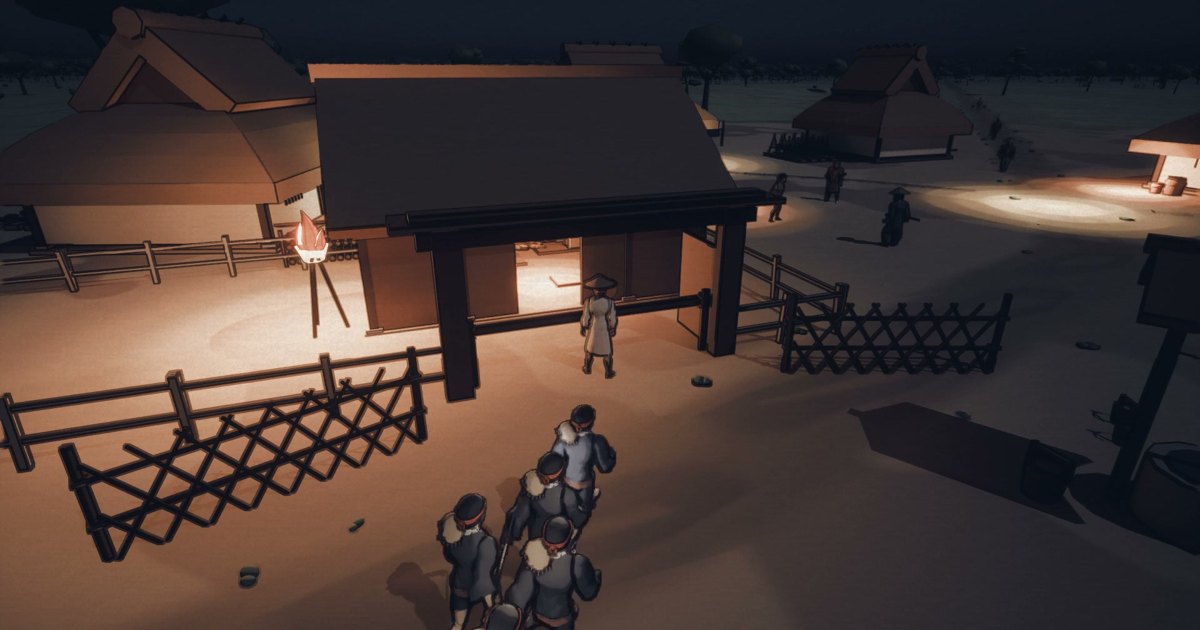
Today is day 39 of making Ranse Biyori. While I wait to hear back from Steam, I want to write down where things stand.
The posts so far have each covered one thing that happened that day. This one is about the whole: what shape the project has taken, and how far it has come.
Five weeks in numbers
From the first commit on September 29 to today:
| What | Count |
|---|---|
| Commits | 9,304 |
| Decision records (ADRs) | 322 |
| Playable builds (playtest tags) | 118 |
| Recorded failures | 213 |
| C++ code | about 230,000 lines (about 120,000 of them tests) |
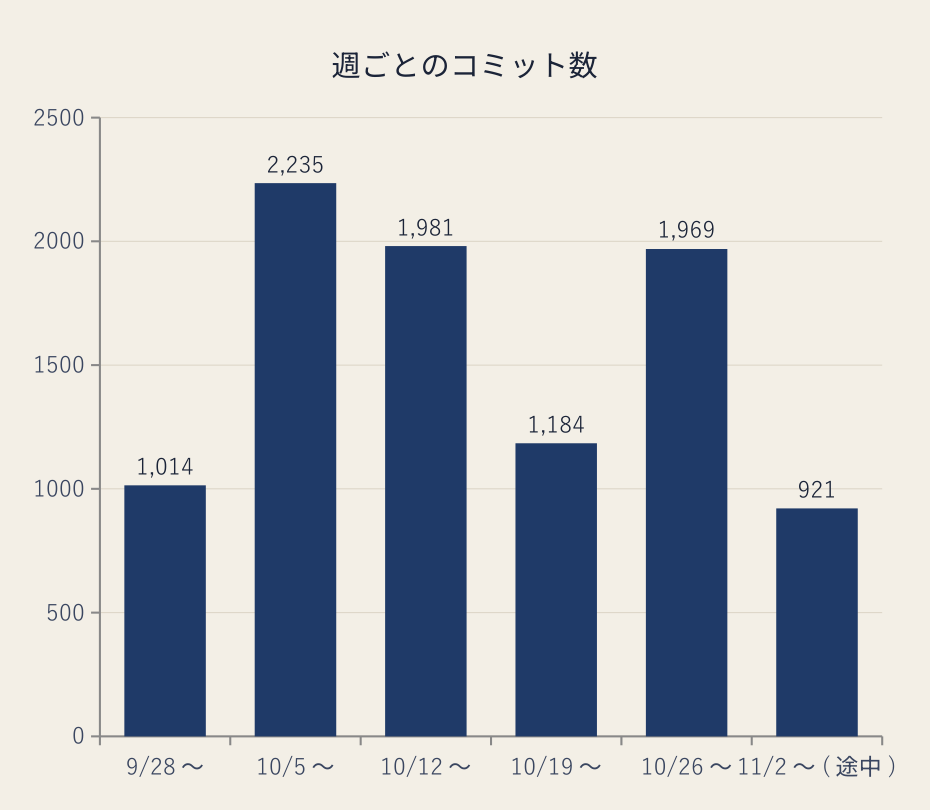
The busiest day was October 6, with 528 commits. Almost all of the writing is done by AI. The only person is me.
What it is built with
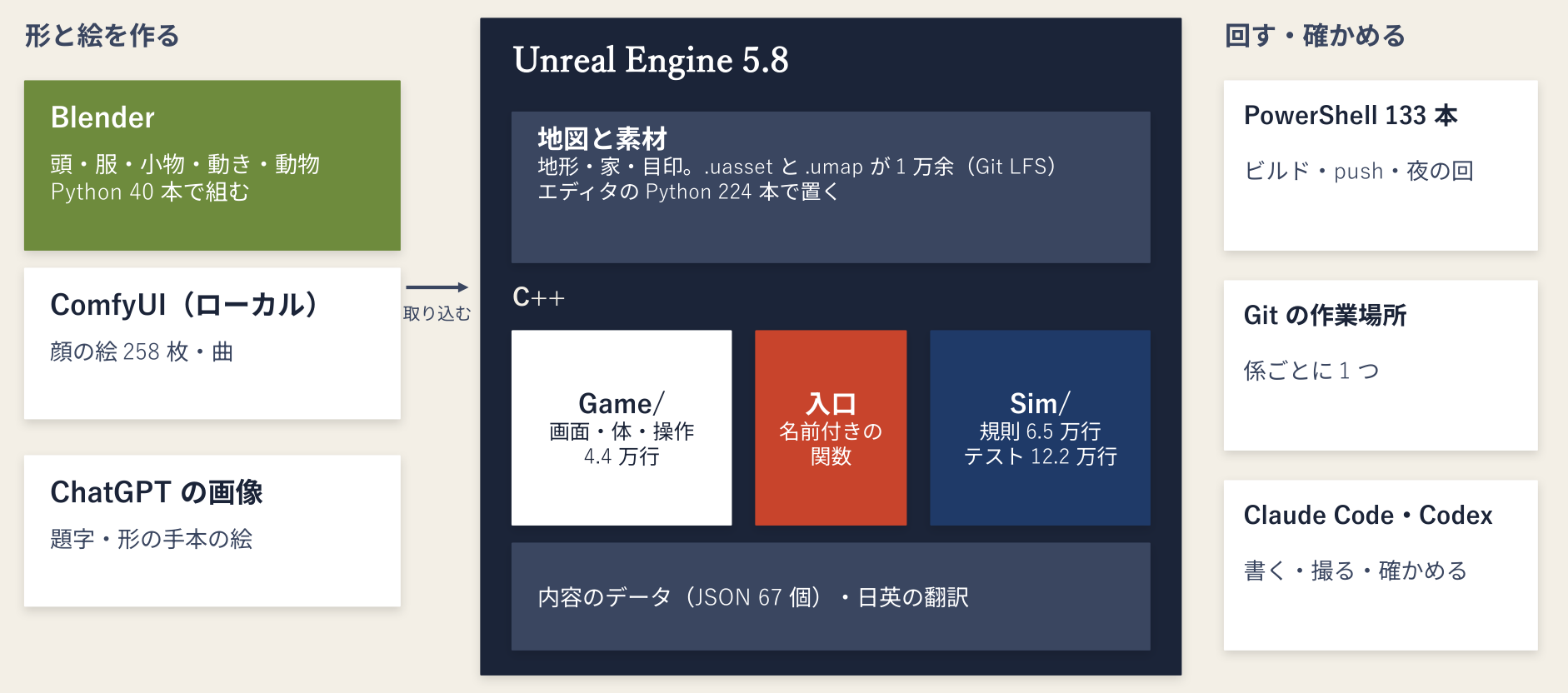
The game runs on Unreal Engine 5.8. The C++ code is split into two big parts.
- Simulation (
Sim/, about 65,000 lines): the part that computes the world inside the game. It decides and remembers who is where, what they carry, and what time it is. Its tests come to about 122,000 lines. - Screen (
Game/, about 44,000 lines): the part that shows what the simulation decided, as people on screen and dialogue windows.
The screen side never writes the simulation’s data directly. It asks through named functions that change the data (the AI calls them “entrances”). Splitting the code this way also splits the AI work: Codex gets the simulation and its tests, and Claude gets the screen and the code where the screen calls into the simulation.
Houses and map marks are placed by 224 Python scripts that drive the UE editor. There are more than 10,000 asset files (.uasset and .umap), kept in Git LFS.
Heads, clothes, small props, motions and animals are made in Blender, also by Python scripts, 40 of them. I look at renders from the front, side, back and above, and only after I approve do they go into UE. The 258 face portraits and the music were made with ComfyUI on my own PC. The brush-written title is something I made with ChatGPT.
Builds, the checks before anything goes into main, and the nightly tests run on 133 PowerShell scripts.
What I do
What I do is decide, and play.
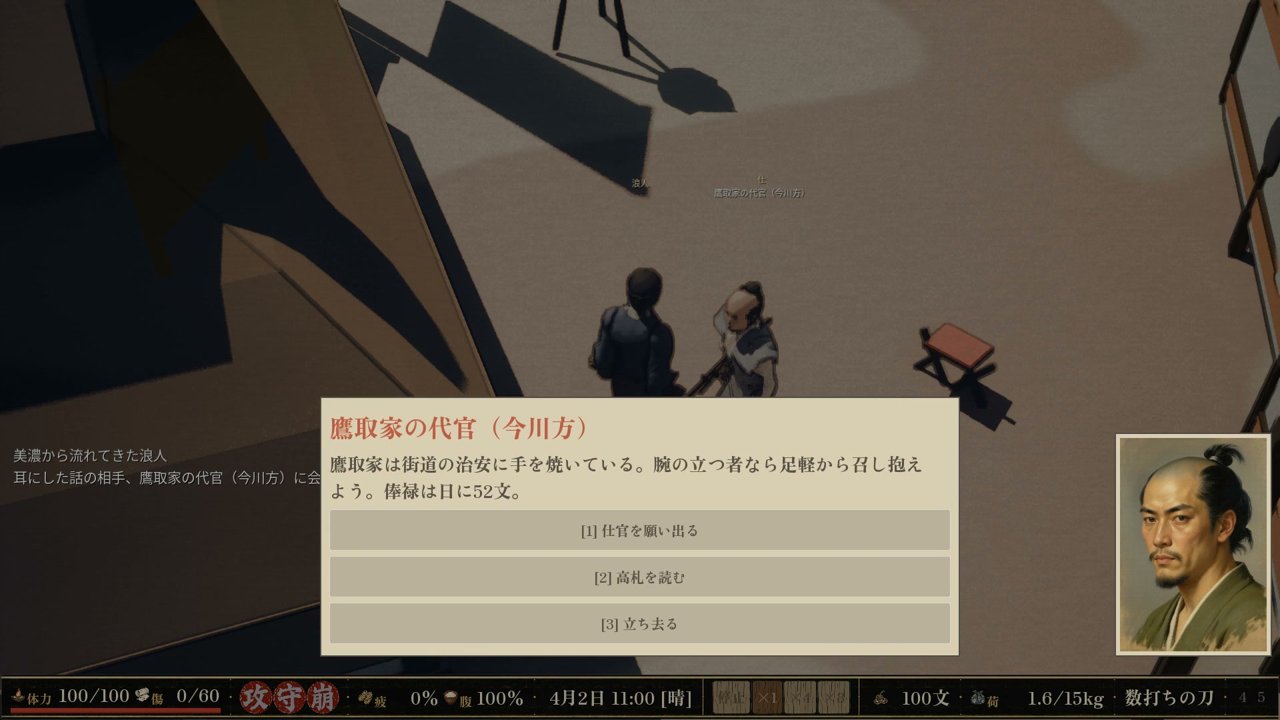
- Decide the pillars of play, and the 3 to 6 things the next build should let me check
- Play that build and say where it differs from what I expected
- Approve large visual changes by looking at pictures
- Decide, before they go in, only the things that cannot be undone: replacing a foundation, changing a principle already decided, taking anything outside, and clean-ups that cannot be reversed
Everything else the AI writes, checks itself, and puts into main first. I look afterwards. How the roles are split is in the October 29 post.
Thirty-nine days
- 9/29 Start by asking a single Claude to do everything
- 9/30 Write the document of working rules (AGENTS.md) and start the decision records (ADRs)
- 10/3 Add a second Claude just for the map and visuals. Add a queue for starting UE
- 10/4 Decide to work in “playtest rounds”. Settle on “History is the weather; your life is the story”
- 10/5 Decide that work goes into main first and I look afterwards
- 10/12 Rewrite AGENTS.md 16 times in one day
- 10/17 Start the failure log. 25 entries on the first day alone
- 10/20 Stop adding new features to the tools for a while
- 10/27 Make the screen side unable to write the simulation’s data
- 11/3 Spend a day closing a function that let any file inside the simulation rewrite its data (the AI called it a “back door”), when it did not need closing
Adding rules did not make them followed
The AI reads its working rules from one document, AGENTS.md. Each time a rule was added, I wrote it in. The document was 5 KB on October 1 and 48 KB by the 20th.
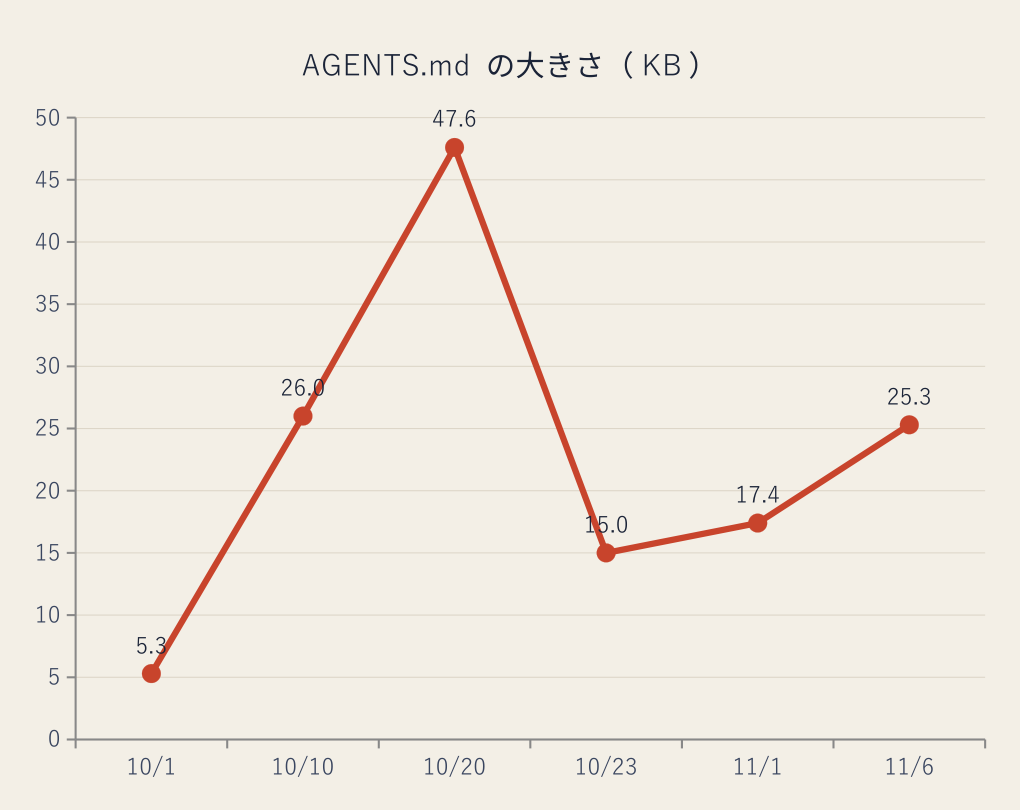
But the AI does not reread a document when it changes in the middle of a task. Neither I nor the AI could tell which rules were current anymore. On October 23 I moved the history out into another document and cut it down to 15 KB. After that, instead of asking in writing, I turned rules into mechanisms that block progress until they are followed. There is now only one tool for putting work into main, and it runs checks before it lets anything in. Today the document is 25 KB, and it is slowly growing again.
Failures are recorded the same day: what happened, why, and what to do next time. When the same failure happens twice, it gets fixed with a tool, not with another line in the document.
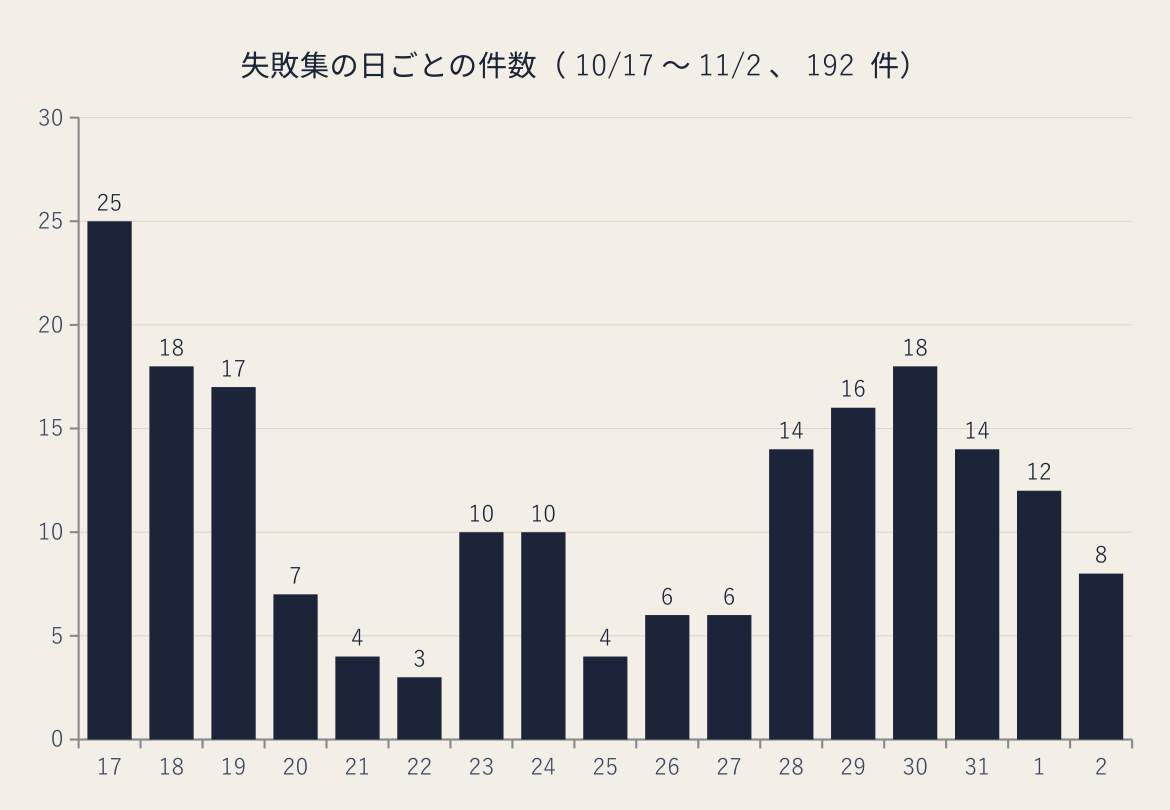
October 19 had 17 in one day. The next day I stopped adding features to the tools.
Five things the failures taught me
- Keep one source of truth (the single owner of a piece of data). How people behave lives only in the rules document; places live only in the map marks. Never writing the same thing in two places helped more than anything else when many AIs work together.
- Block it in the code, rather than write it down. The AI does not reread documents. Make the wrong shape fail to compile or fail a check.
- Check what a number is actually counting. I watched a count of 35 back-door uses, and it stayed at 35 through 13 rounds of splitting files. It only counted one way of writing it (The house I could not tidy up).
- Measure; don’t decide the cause from a picture. The farmer whose sleeves looked doubled had nothing wrong with his clothes. Two people were standing on the same spot (It’s not going well at all).
- Ask about a word you don’t understand, right then. I answered “top priority” without asking what the AI meant by “back door”, and half a day was gone (I kept answering the AI without understanding its words).
Now
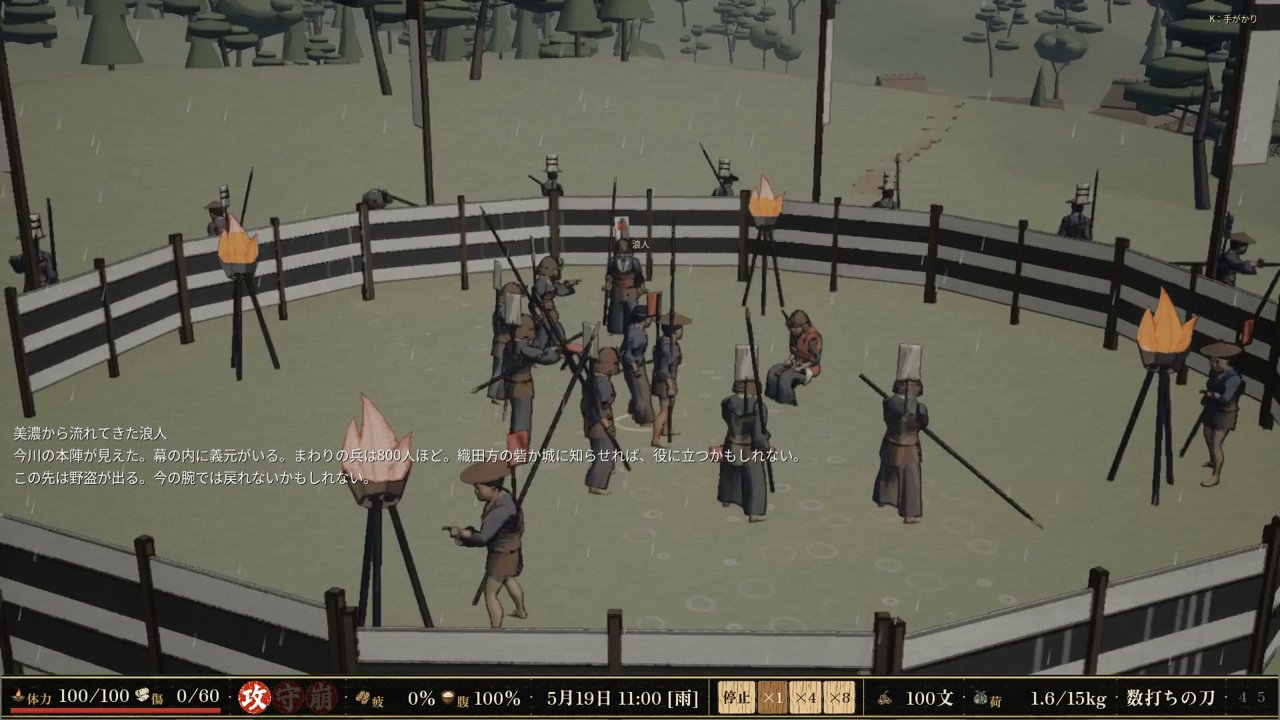
I applied to Steam on October 10 and am still waiting for the review. With so many more people making games with AI, there seem to be a great many applications, and the review is taking time. Meanwhile I am making a 55-second trailer for the store page, and the third version is done.
For Early Access, the plan is to cover 1560 to 1568, from the Battle of Okehazama to Nobunaga’s march on Kyoto. There will be three maps: Owari and Mikawa, Mino, and Omi with Kyoto. Right now there is one map, eastern Owari.
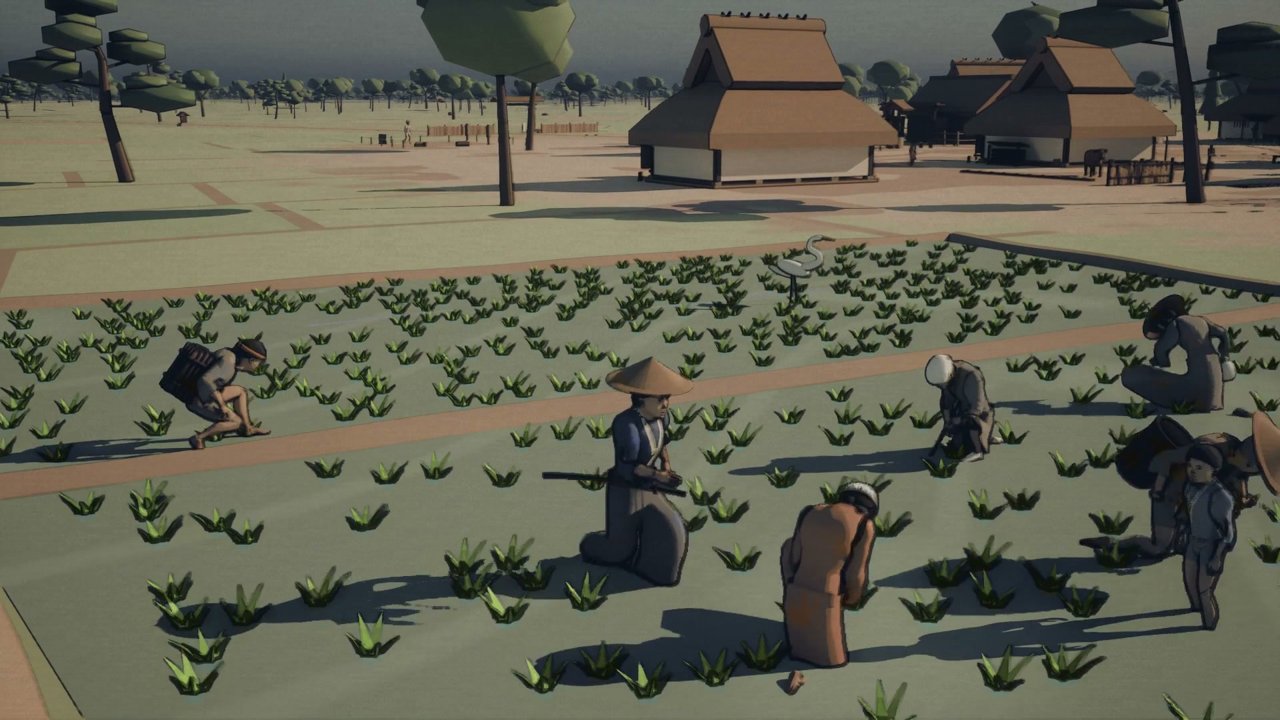
Many AIs work on this, but the decisions are mine. Which picture feels like Ranse Biyori, and whether it is fun to play: those I decide by playing.