
Ranse Biyori is a game about walking through Owari province in 1560. I started it on September 29. Today is day 48.
In those 48 days: 11,167 commits to main (counted today, since September 29). The game is built by a team of AI agents, 7 Claude and 3 Codex. I have not written a line of the code.
The oldest video is a teaser from October 7, day 9. I watched it again, and there was much less in it than I remembered. So I put it next to today’s game, in the same kinds of places.
Day 9 is on the left, day 48 on the right. Here are the four places, one at a time.
The Imagawa camp
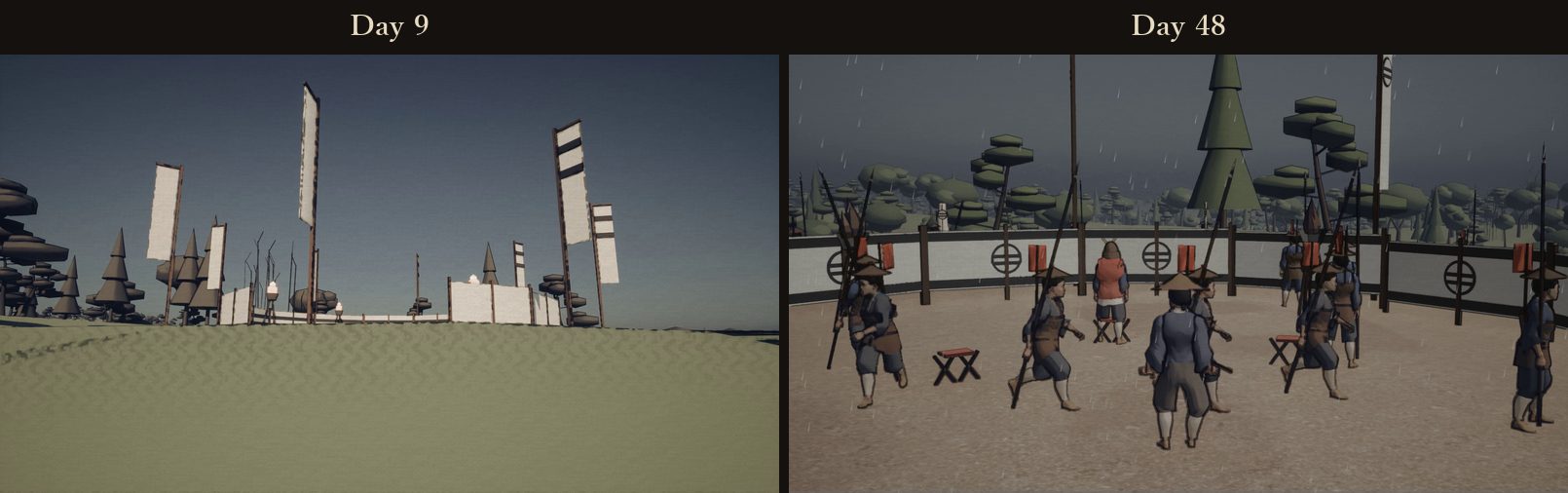
On day 9, the camp was banners and curtains, and nobody at all. Not even a guard.
Now the curtains carry a family crest, and foot soldiers walk around with spears. It rains, too. For the castles painted in the far distance, see the November 14 post.
A house at night
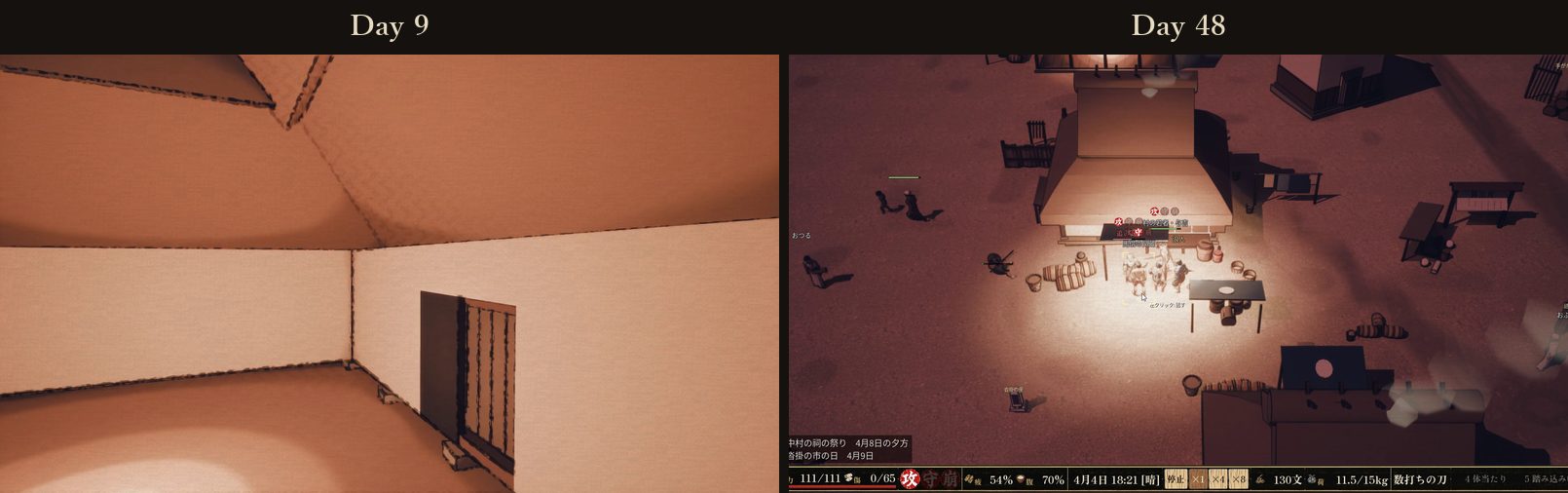
On day 9, you could already walk into a house. Inside, though, it was an empty box: walls and a door.
Now the houses light up at night, and people gather in front of them. I wrote about the lights in the night lights post, and about walking into houses in the open doors post.
The town street
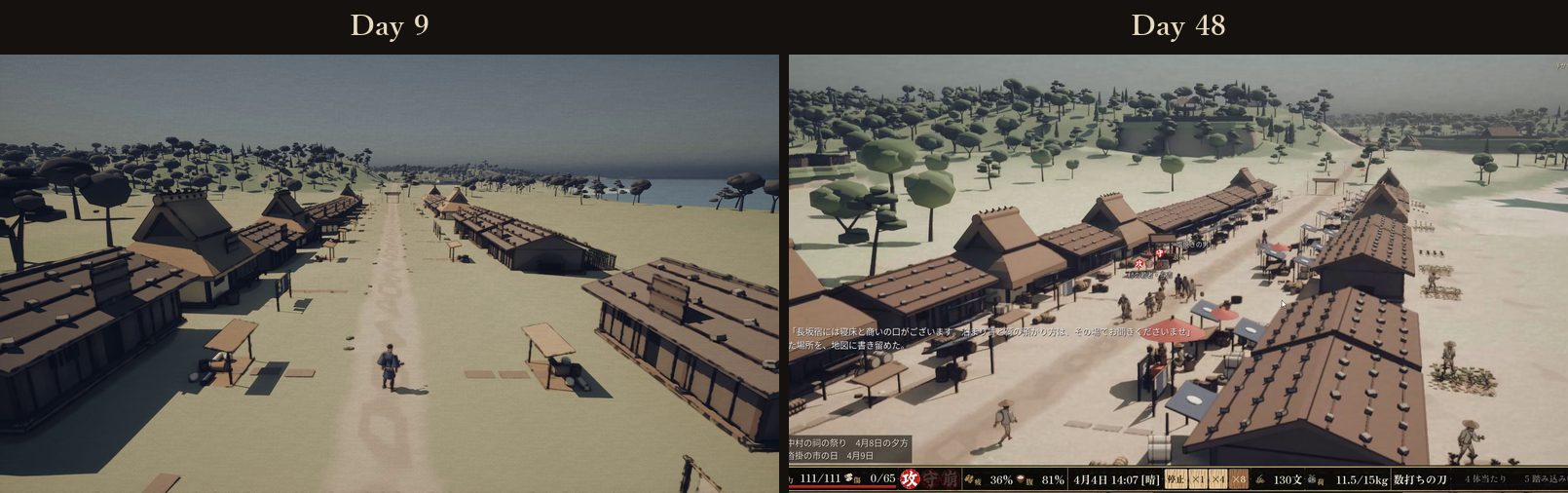
On day 9, the town had buildings but only one person. You had the whole place to yourself.
Now, on market days, stalls go up and people come and go. Each townsperson has a job and a place to be during the day (more on that here). The street is busy not because we added more art, but because people started living there.
The road to the village
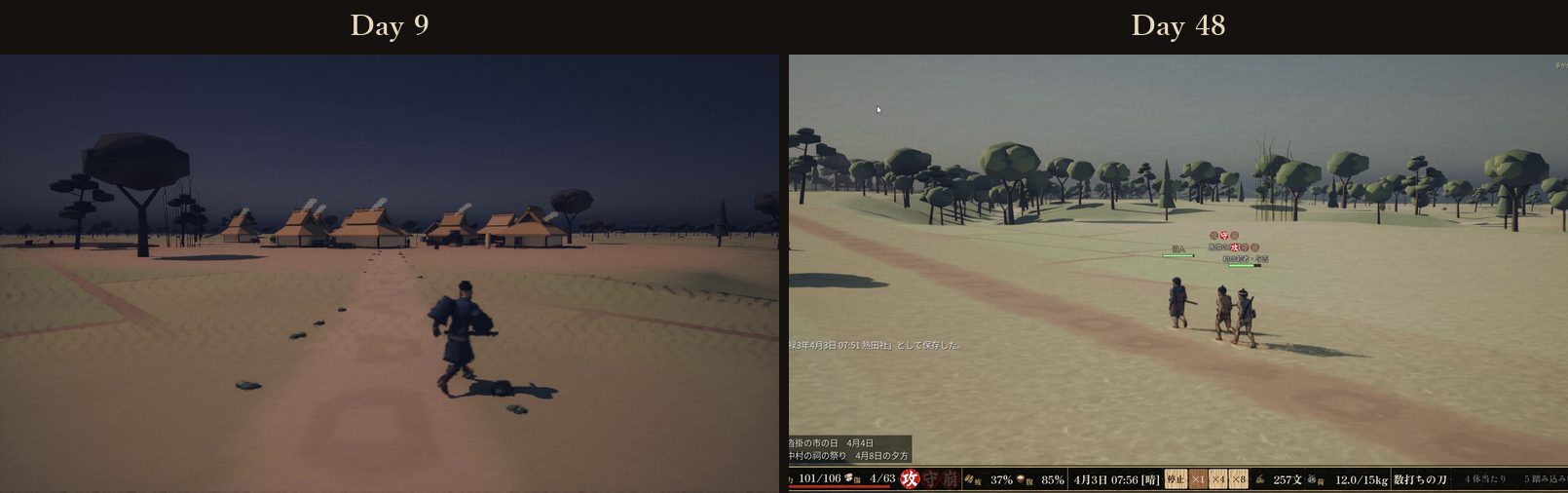
On day 9, the sky was navy blue all day, as if it were always night. The ground was one sandy color, and the stones by the road were the most interesting thing in the picture.
Now there is morning light and shadow, trees along the road, and two companions walking with you. The bar at the bottom shows the date, your money and what you carry. I wanted a game about living in 1560, not just walking through it.
People made the screen busy, not art
Looking at the four pairs together, one thing stands out. The camp, the house at night, the town street: what changed was not the shape of the buildings. People arrived, lived there and started moving around.
Rebuilding the shapes only started today.
If a scene feels empty, add people before you add props. One person walking by turns a set into a place.
What we rebuilt today
From here on, the pictures are not day 9. They are yesterday and today. Today we rebuilt the village props in Blender. The trees are being rebuilt too, but are not finished yet. Many of the old props were just boxes and tubes put together.
First, the barn where the game begins.
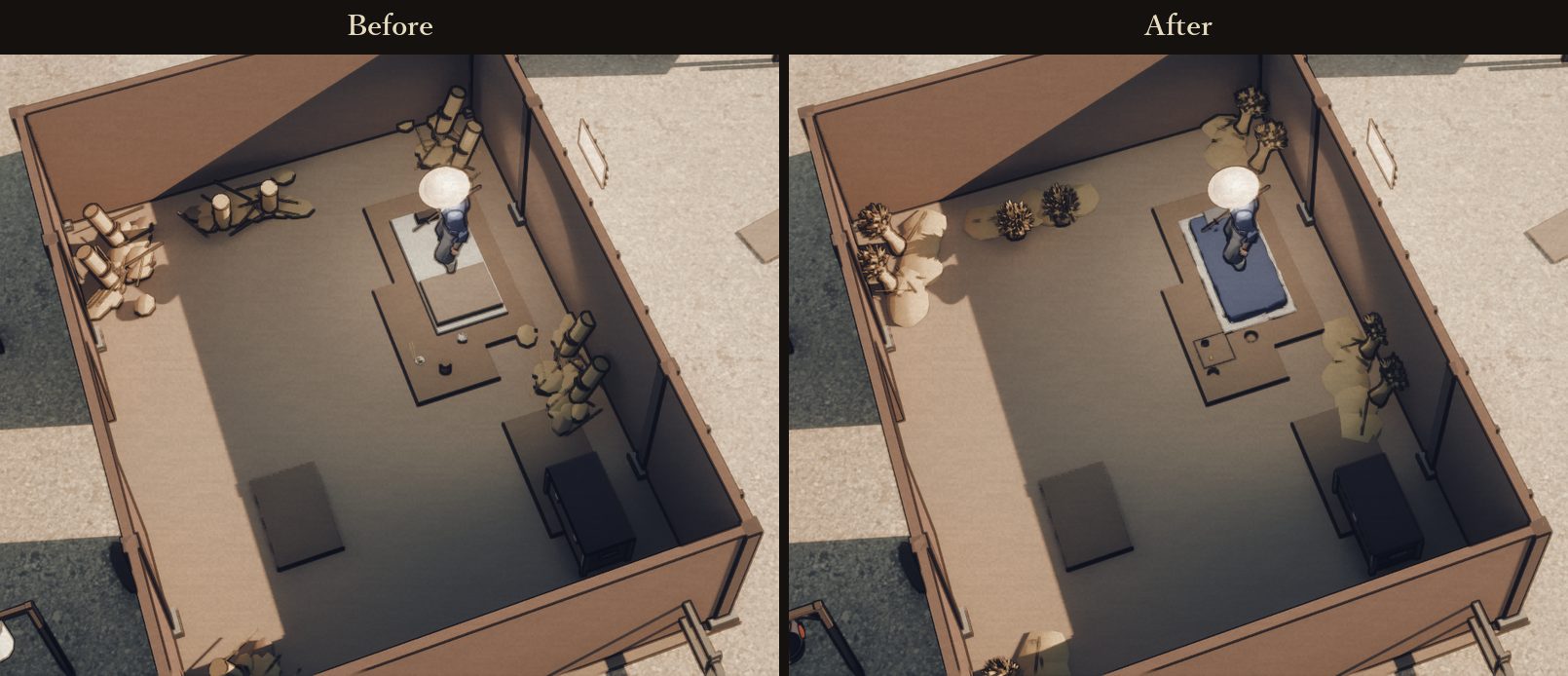
The straw bundles looked like sawn logs, ready for the fireplace. Now they look like sheaves of straw. The bed, which was a white board, is now a navy futon.
Two of the fifteen village props we rebuilt:
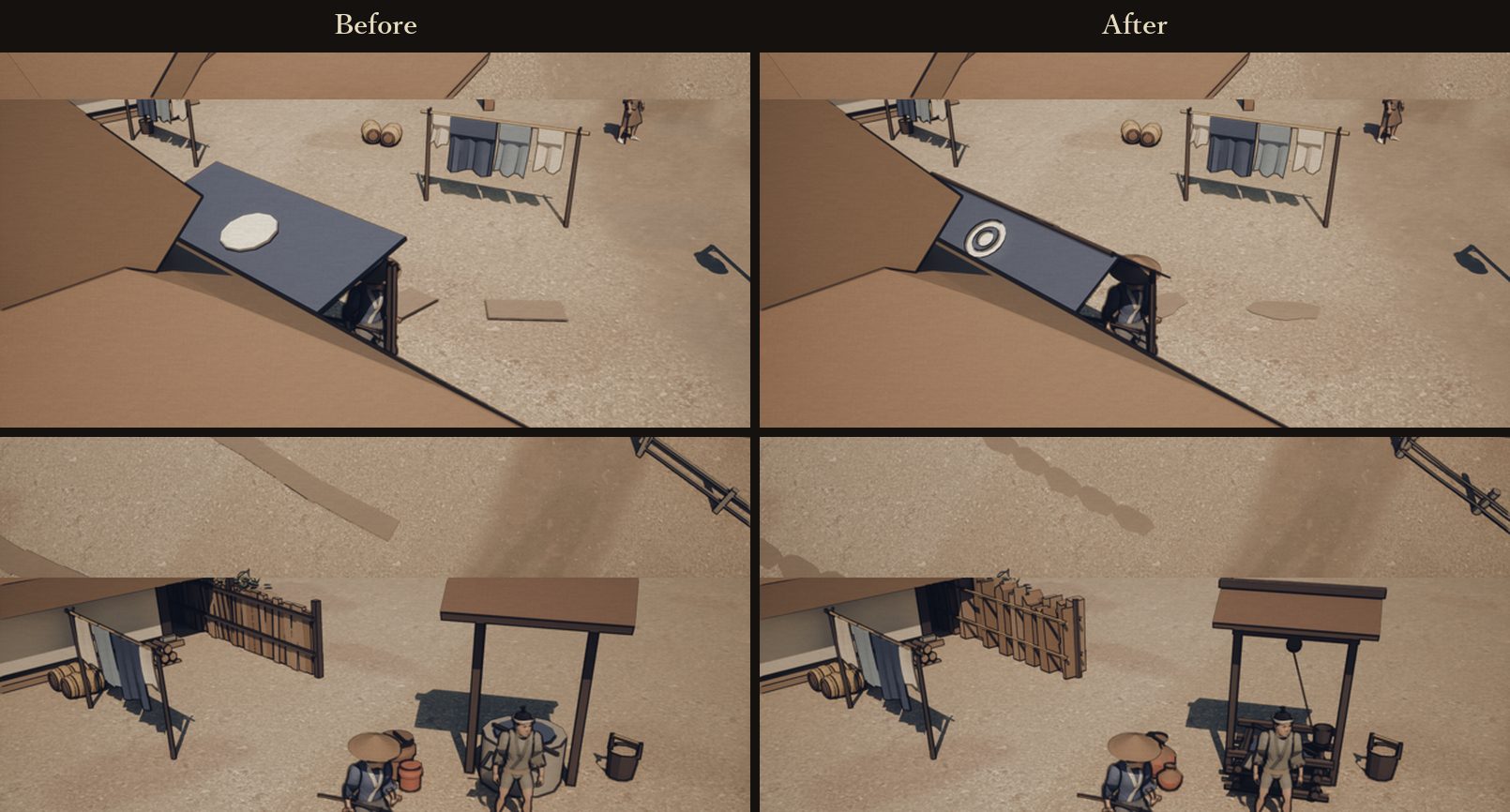
The sign that marks a house you can enter looked like a white plate sitting on a navy tray. Now it is a sign with a crest. The well was a box with a roof. Now it has a frame and a pulley, and looks like something you could draw water from.
Next: texture
Side by side, the shapes have come a long way. But every surface is still flat paint. The wood, the straw and the earth are all smooth.
Next, we will add real-looking texture: wood grain, the lines in straw. Then we will line up the same places again.